When I’m editing, the questions I ask myself most are, how does it feel to be in this situation? To be in this place? To be this person? How can I help the viewer either feel it themselves or at least understand what is being felt by the subject? And how little needs to be said, how few facts does a viewer need in order to understand the emotional truth without being confused? There are, of course, many other considerations, but that’s where everything starts for me. Documentaries aren’t lectures, they are movies (lectured the editor).
This has allowed me to help share the stories and the humanity of people who speak languages I don’t understand, contend with challenges I’ve never faced, accomplish things for which I haven’t skills. Along the way, I have collaborated with some amazing filmmakers and the films I’ve worked on have been shortlisted and nominated for Oscars, nominated for and won Emmys, nominated for and won Peabodys, awarded the Humanitas Prize, have made top-docs-of-the-year lists, have won jury prizes and audience awards at countless festivals around the world, and have been an answer (or is it a question?) on Jeopardy! What I’m most proud of, though (although the Jeopardy! thing is a close second), is that I know the movies I’ve helped make have affected people. They have either moved people into action or simply moved them. The first feature I edited, for instance, Louder Than a Bomb, centered around an annual youth poetry slam in Chicago, helped inspire the growth of the event to thirteen other cities across the United States. Teenagers saw this movie and decided they wanted to write and perform poetry! The movie made them feel something.
Now, here’s the part where I talk about myself in third person which, if I’m fortunate enough to have a chance to work with you, you can copy and paste into grant applications:
With almost twenty years experience as an editor and creative collaborator, John Farbrother is known for his ability to quickly identify and distill the emotional core of a scene, helping directors tell thoughtful and engaging stories. He co-edited the Academy Award nominated and Emmy winning PBS Frontline documentary, Abacus: Small Enough to Jail, directed by Steve James. He also edited the MTV Documentary Films feature, Finding Yingying, directed by Jiayan “Jenny” Shi, which won the 2020 Documentary Special Jury Prize for Breakthrough Voice at South by Southwest and the China Academy Award for Best Foreign Language Documentary. John’s first feature, Siskel/Jacobs’ Louder Than a Bomb, won the Humanitas Prize for Documentary and was selected as part of the U.S. State Department’s 2011 American Documentary Showcase. Other recent work includes two PBS Independent Lens documentaries, 2025 Peabody Award winning, One With The Whale, and Violet Du Feng's 2024 Peabody Award nominated, Hidden Letters, which was also shortlisted for the 2023 Academy Award for Best Documentary. He recently teamed up again with Violet Du Feng for The Dating Game, which premiered at the 2025 Sundance Film Festival.
Another thing or two...
First, here's a link to my resumé:
Second, while I'd never promote myself as a motion graphics artist, I do have some ability with After Effects, which I've put to good use on some smaller projects and on shows like American Greed, so I am often able to at least help conceptualize motion graphics for a project and create pretty decent temps, as in the diary sequences of Finding Yingying (final motion graphics by 423 Motion, Jesse Kerman and Leah Uberseder). And sometimes my temp executions make it to the final film, as in the subtle Nushu graphics in the Hidden Letters poetry sequences. I'll be posting a brief reel of my work here soon.
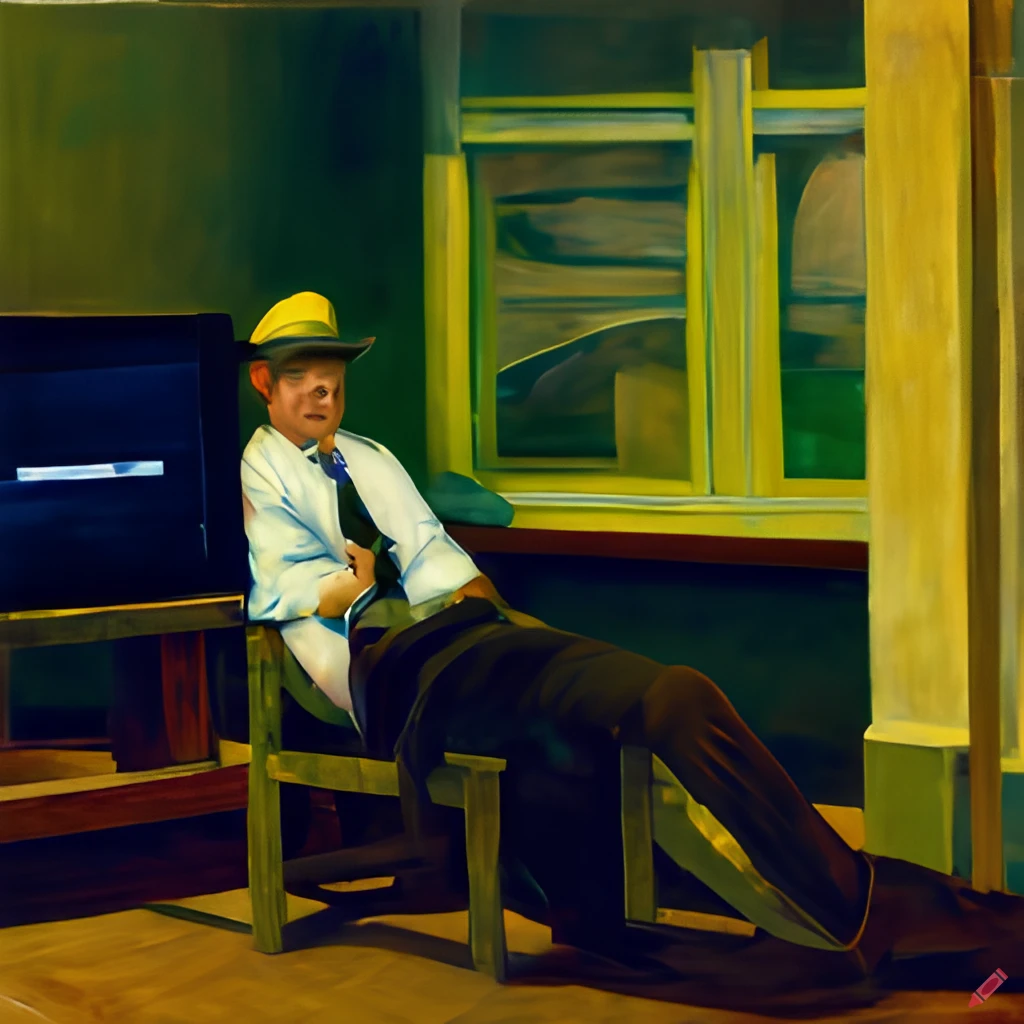
An Edward Hopper painting of me at work, as envisioned by Craiyon.
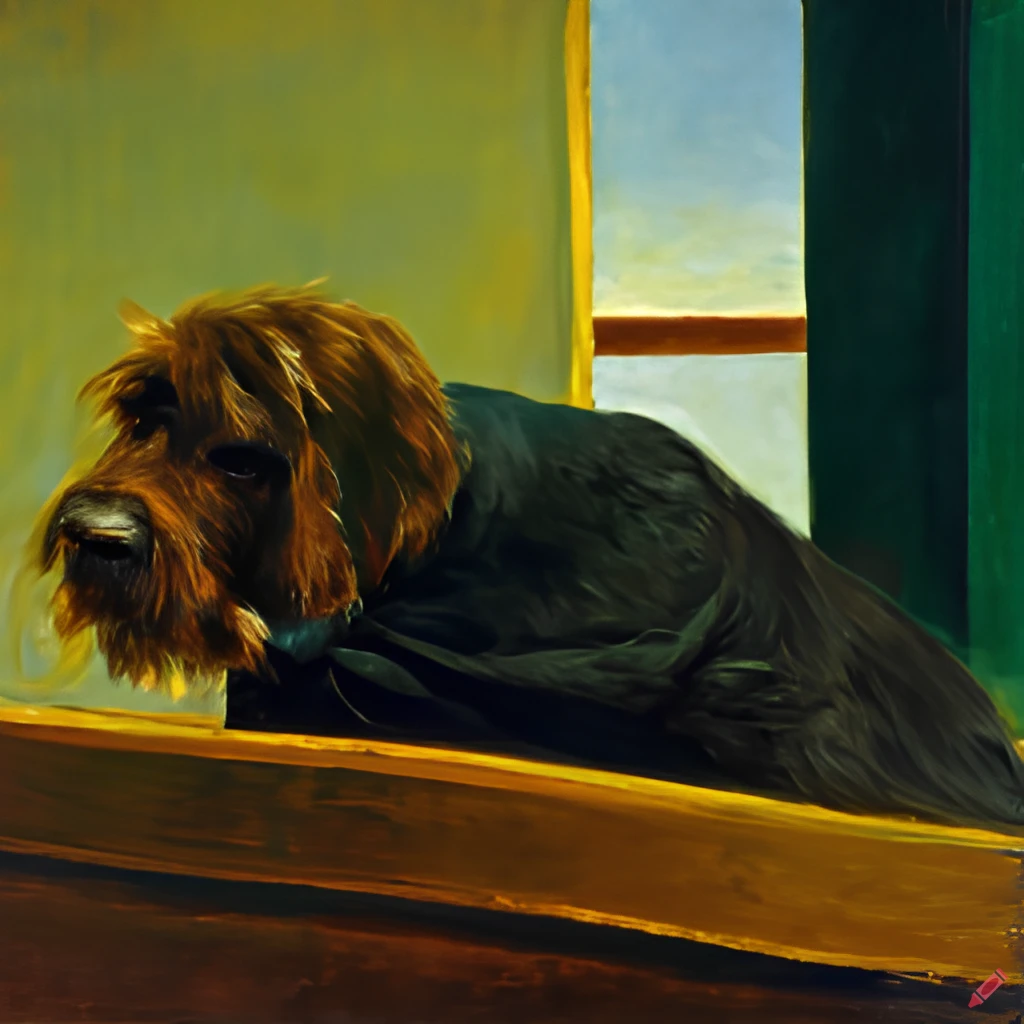
An Edward Hopper painting of Bowie, the dog that sleeps in a chair behind me while I work, as envisioned by Craiyon.